Comment of Lapsa, D., Janeliukstis, R., Metshein, M., & Selavo, L. (2024). PPG and Bioimpedance-Based Wearable Applications in Heart Rate Monitoring—A Comprehensive Review. Applied Sciences. https://doi.org/10.3390/app14177451
By Natalia Rosso
Have you ever wondered how your fitness tracker or smartwatch knows your heart rate? A recent paper dives into the technology behind these convenient devices, explaining how they can continuously monitor your health in a non-invasive way. This review article, titled “PPG and Bioimpedance-Based Wearable Applications in Heart Rate Monitoring,” by Dr. Lapsa et al. explores two key technologies:
photoplethysmography (PPG) and electrical bioimpedance (EBI).
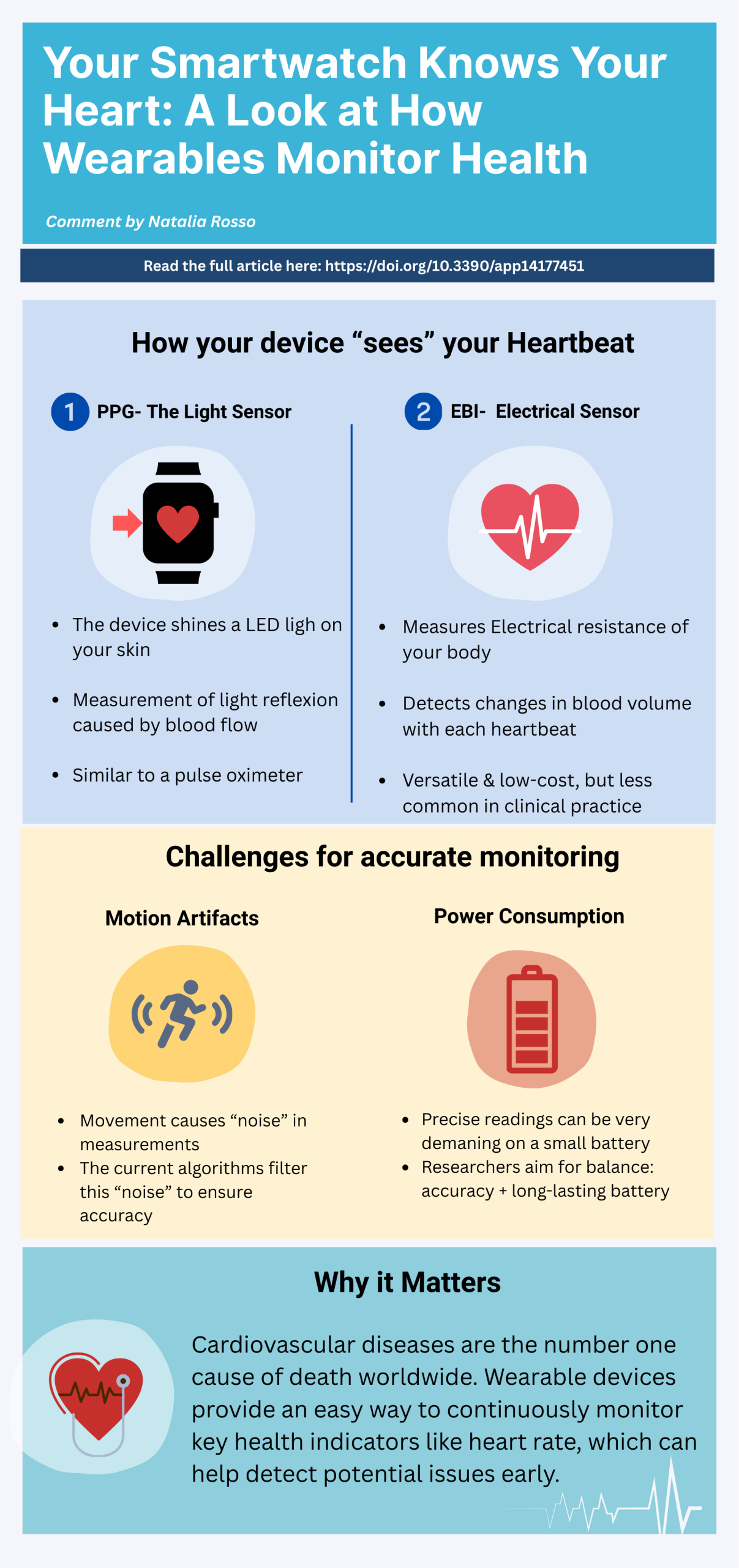
The Two Ways Your Device “Sees” Your Heartbeat
Think of it like this: your device uses two different methods to listen to your body’s rhythm.
- PPG (The Light Sensor): This is the most common method you’ll find in smartwatches and fitness bands. The device shines a light, typically an LED, onto your skin. A sensor then measures the changes in light reflection caused by the blood flowing through your veins with each heartbeat3. This is like how a pulse oximeter works by shining a light through your finger to measure blood oxygen.
- EBI (The Electrical Sensor): This technology measures the electrical resistance of your body. When your heart beats, the volume of blood changes, which in turn changes the body’s electrical impedance. The device can detect these tiny changes to get a reading. The paper notes that while this method is versatile and low-cost, it is not as widely used in clinical practice yet.
The Challenges of Making it Work on the Move
One of the biggest hurdles for these devices is accurately measuring signals while you’re moving. The paper calls these disturbances
“motion artifacts.” Imagine trying to measure your pulse while jogging—it’s tricky, right? The paper discusses how various algorithms are used to filter out this “noise” and ensure the device’s readings are accurate, even when you’re active.
Another challenge is
power consumption. The advanced calculations needed to get a precise reading can be very demanding on a small battery. Researchers are constantly working to find a balance between accurate measurements and a long-lasting battery.
A Step Toward Better Cardiovascular Health
Why is all this research so important? Cardiovascular diseases are the number one cause of death worldwide. Wearable devices provide an easy way to continuously monitor key health indicators like heart rate, which can help detect potential issues early.
By combining and improving technologies like PPG and EBI, engineers and researchers hope to create the next generation of wearable devices. These new devices will be even more energy-efficient, accurate, and comfortable, ultimately helping us better track and manage our heart health.