
By Natalia Rosso
Scientific research does not exist in isolation. It is funded by society, intended to improve lives, and increasingly expected to inform public decisions, from health and technology to climate and policy. Yet despite the rigor and quality of modern research, a persistent gap remains between what scientists know and what the public understands.
Closing this gap is no longer optional. Clear communication is part of the scientific responsibility.
Communicating Science Requires Changing How We Speak
Within academia, communication is often equated with publishing papers, presenting at conferences, or exchanging results with peers. These activities are essential for advancing knowledge, but they represent only one dimension of communication. Speaking to the general public requires a different approach altogether.
Public-facing communication demands a conscious shift in style. Technical language must be replaced with clear, accessible wording. Equations, acronyms, and dense jargon should be minimized, while explanations are grounded in context, narrative, and relevance. The goal is not to reduce complexity, but to make it understandable.
What appears self-evident to a specialist can be confusing, or meaningless, to a non-expert. Translating complex findings into messages that are both accurate and accessible does not dilute science. It calls upon a different, equally important skill: the ability to make knowledge intelligible without compromising its integrity.
Validated Information as a Public Good
In an era of instant information and unchecked claims, the need for reliable, evidence-based communication has never been greater. When scientific findings are not communicated clearly, alternative and often unreliable interpretations quickly emerge.
Without visible scientific voices, complex issues are easily reduced to simplistic or misleading narratives. Repeated often enough, unverified claims can appear credible, gradually eroding trust in science. Confusion replaces understanding, and skepticism grows where clarity is most needed.
Clear and transparent communication allows people to distinguish between evidence and speculation. This distinction is especially critical in fields that directly influence daily life, such as health, environmental policy, and technology, where misunderstanding can have tangible and lasting consequences.
Bringing Science Closer to Its End Users
Effective communication does more than convey information; it builds connection. When scientists explain their work in accessible terms, patients are better equipped to understand health guidance, citizens can see how research affects their lives, and policymakers gain clearer foundations for decision-making.
As science becomes more accessible, it also becomes more human. This proximity fosters trust and helps ensure that research remains aligned with real-world needs. Communication, in this sense, is not an add-on to research but a bridge between knowledge and impact.
A Skill Scientists Are Rarely Trained For
Despite its importance, science communication is rarely treated as a core competency. From early in their careers, researchers are trained to write academic papers, deliver technical presentations, and communicate with peers. Years are devoted to learning precision, rigor, and caution, qualities essential to good science.
What is often missing is guidance on how to step outside that expert circle. Scientists are seldom taught how to explain complex ideas clearly to non-specialists, how to engage audiences without technical backgrounds, or how to communicate uncertainty honestly and effectively. The ability to translate knowledge is frequently assumed rather than taught.
In practice, it does not come naturally. For many researchers, public communication feels unfamiliar, uncomfortable, and time-consuming. Simplifying language can feel risky, and omitting detail can feel like losing control of the message. As a result, dissemination is often treated as an added burden rather than an integral part of the scientific process.
This is not a failure of individual scientists. It reflects a structural gap in academic training—one the scientific community can no longer afford to ignore.
When Science Is Silent, Misinformation Speaks
Where clear scientific communication is absent, misinformation finds space to grow. Simple, emotionally appealing messages, regardless of their accuracy, are easier to understand and share than nuanced explanations grounded in evidence. When scientists do not actively participate in public discourse, unvalidated claims step in to provide easy answers to complex questions.
Ironically, misinformation often succeeds not because it is persuasive, but because it is accessible.
A Call to Action
The scientific community is uniquely positioned to address this challenge. By investing in communication, it can equip researchers with the training, tools, and institutional support needed to reach audiences beyond their peers. Scientists should not be expected to do this work alone; effective communication is often strongest when developed in collaboration with professional communicators, designers, and educators.
When communication is treated as a shared responsibility, scientific integrity is not weakened, it is reinforced. Clear language and accessible formats make evidence more visible, not less rigorous. Openness and accuracy can grow together.
For this to happen, dissemination must be recognized for what it truly is: a core component of scientific excellence, not an optional task added at the end of a project.
Conclusion
Science communication is not about simplifying science; it is about making knowledge usable.
In a world facing increasingly complex challenges, society needs scientific voices that are clear, trustworthy, and accessible. If science is to have real impact, it must not only generate knowledge but also share it responsibly and openly.
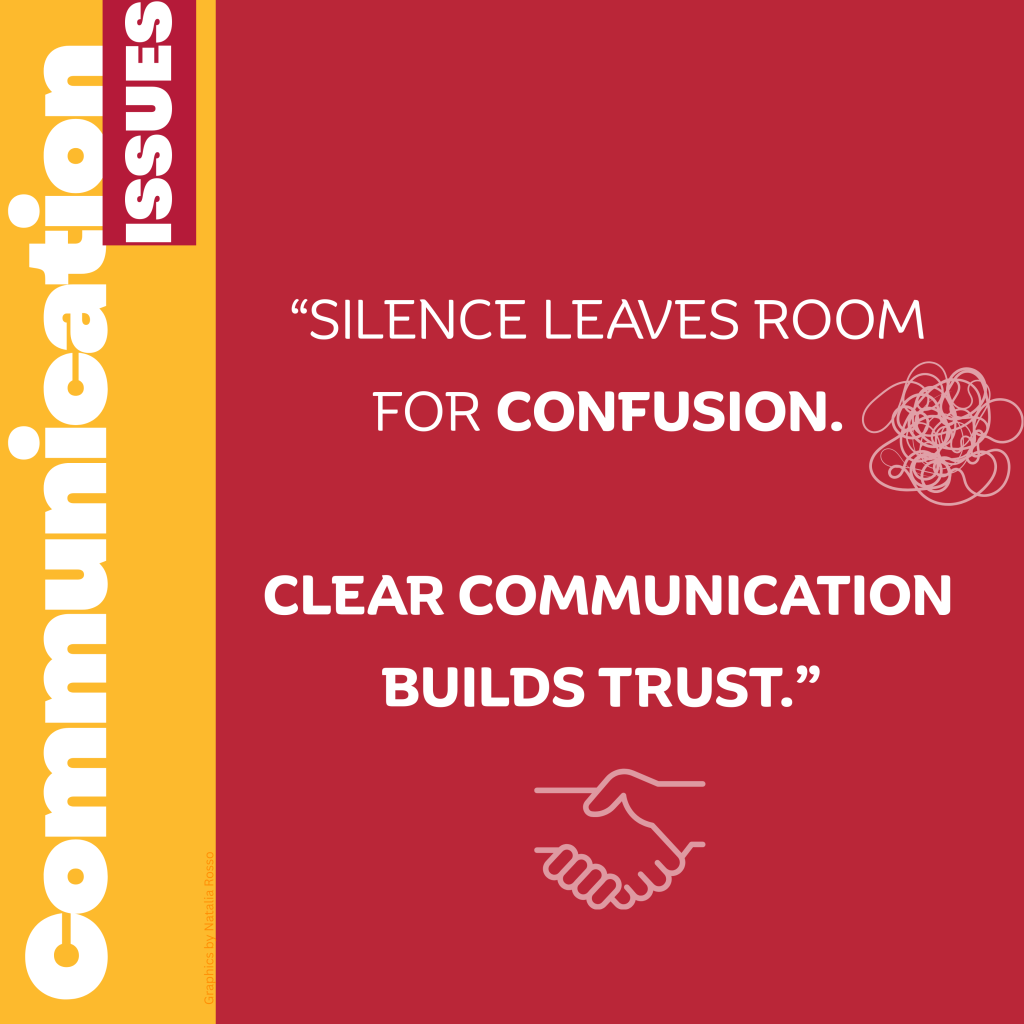
Silence leaves room for confusion. Clear communication builds trust.