Comment “A Model-Based Approach for Glucose Control via Physical Activity” by De Paola, P. F., Borri, A., Paglialonga, A., Palumbo, P., & Dabbene, F. (2025). In IOS Press Ebooks Studies in Health Technology and Informatics (Vol. 327, pp. 27–31). IOS Press Ebooks. https://doi.org/10.3233/SHTI250267
By Natalia Rosso
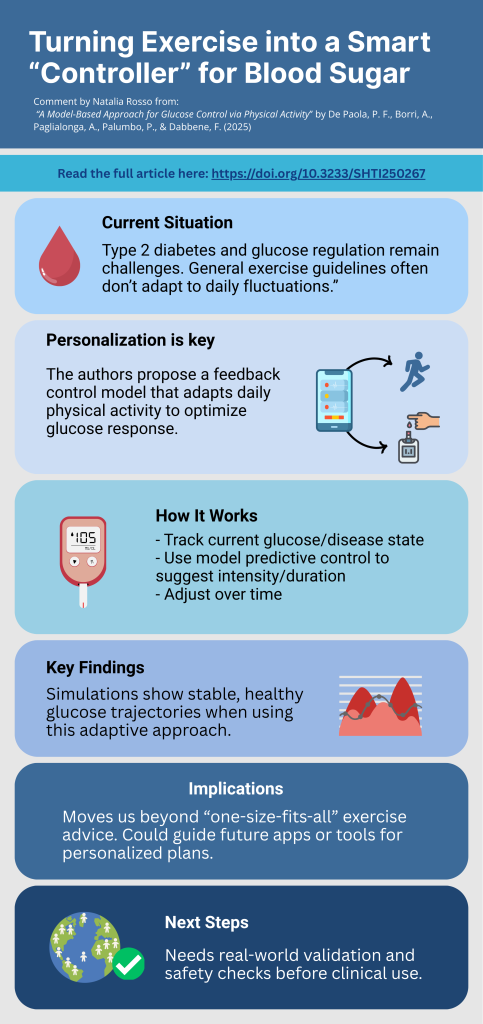
The authors propose a mathematical way to translate how much and what kind of exercise a person with—or at risk of—type 2 diabetes should do, to help regulate their blood sugar levels better over time. They build a “feedback control law” that recommends physical activity (e.g., intensity, duration, frequency) depending on how the person’s glucose levels and disease progression are evolving. Their hope is that such a method could support future tools or apps that tailor exercise to the individual’s changing state.
Why this is interesting and important
- We already know exercise helps
It’s well established in medical studies that regular physical activity slows down the development or worsening of type 2 diabetes. But one of the challenges is quantifying just how much—and of what kind—exercise someone should do on a given day, as conditions change (for example, their weight, insulin sensitivity, or glucose variability may shift). The authors aim to fill that gap.
- From general guidelines to personalized suggestions
Current clinical guidelines tend to give fairly broad advice: “30 minutes of moderate activity most days,” etc. The method in this paper is more dynamic: it’s a model that continuously adjusts the recommended exercise based on the person’s current physiological status, using the idea of feedback control (a concept borrowed from engineering). In other words, it is trying to make exercise recommendations responsive to what’s happening in the person’s body.
- Bridges medicine and control theory
The authors adapt a known compact model of diabetes progression (a simplified model that captures key dynamics of blood sugar, insulin, and tissue sensitivity),and augment it to incorporate the long-term effects of regular exercise. Then they employ a model predictive control (MPC) framework, a method from engineering used to optimally steer processes over time. This cross-disciplinary approach is a strength—it shows how techniques from systems science could contribute to personalized health management.
- Promising early results
Though the paper reports only simulations (i.e. computer experiments) rather than clinical trials, the simulations show that their feedback controller can lead to stable, healthy blood sugar trajectories that align with what one would expect from clinical evidence. That suggests the method is plausible, and worth further testing in more complex models and eventually in real human studies.
What to take with a grain of salt (cautions)
- Simulations ≠ real life
The results are promising, but they come from idealized computer models, not human trials. People are more variable and messy: lives involve diet, stress, illnesses, medication changes, and so on.
- Model simplicity has pros and cons
The underlying diabetes model is a “compact” one (simplified) so it is computationally tractable, but it may miss many subtleties and individual differences. Real glucose dynamics can be affected by many factors—genetics, gut microbiome, other co-morbid conditions—that simpler models may not account for.
- Translating “controller outputs” into real recommendations is nontrivial
Even if the controller says “do 25 minutes of moderate exercise today,” turning that into a safe, realistic, and motivational plan for a patient involves behavioral, medical, and safety considerations. The path from theory to an app or decision support tool is still long.
- Need for validation and safety checks
Before such a system could be used in real life, it would need careful validation: retrospective data tests, prospective controlled trials, safety monitoring, and personalized calibration, among others.
What this could mean for the future
If this kind of method is refined and validated, here are a few possible benefits:
- Adaptive, personalized exercise advice
Rather than fixed weekly targets, people may receive daily exercise suggestions tailored to their current metabolic state. This could help improve adherence and efficacy.
- Integration into digital health tools
This approach could be embedded in apps or wearable systems that already monitor glucose, activity, and other parameters, offering smart coaching or alerts.
- Better prevention and management
For those at risk of developing type 2 diabetes or in early stages, dynamically optimized activity could slow progression more efficiently. Even among diagnosed individuals, it might help maintain stable glycemia and reduce complications.
- Modeling + AI in medicine
This work is a demonstration of how control theory, modeling, and predictive algorithms can intersect with medical care to produce more precise recommendations.
Bottom line (in everyday language)
Doctors and scientists have long known that exercise is good for preventing and managing type 2 diabetes. What this paper does is try to make that advice smarter — not just “go walk 30 minutes”, but “given how your body’s doing today, this is the optimal amount and intensity of activity to help manage your blood sugar.” They built a model and ran experiments in a computer, and the results look promising. But it’s early days — the method still needs real-world testing.
If brought into practice carefully, such an approach could help people live healthier lives by giving them guidance that adapts to them, rather than expecting them to follow static rules. It’s a step toward more personalized and dynamic health care.
Read the full scientific paper here: https://doi.org/10.3233/SHTI250267