Comment of: Milito, M; Mihajlovic, M; Mallia, A; Ghilardi, S; Tiribelli, C; Bonazza, D; Rosso, N; Palmisano, S; Banfi, C; Giraudi, PJ Low-Abundance Proteomics Reveal Pleiotrophin and Fibroblast Growth Factor-21 as Biomarkers of Metabolic Dysfunction-Associated Steatohepatitis https://doi.org/10.3390/ijms262210943
By Natalia Rosso
A new study from the Italian Liver Foundation NPO MASLD Group, conducted in collaboration with Azienda Sanitaria Universitaria Giuliano Isontina (ASUGI) and Centro Cardiologico Monzino, IRCCS, and now published in the International Journal of Molecular Sciences, marks an important step forward in the search for reliable, non-invasive biomarkers for metabolic dysfunction-associated steatotic liver disease (MASLD) and its inflammatory form, MASH.
This work addresses one of the most pressing clinical challenges in the field: differentiating MASH from the non-inflammatory stages of MASLD without relying on invasive liver biopsy. Despite recent progress, clinicians still lack accessible, accurate, and reproducible tools for detecting the inflammatory transition that carries the greatest risk for fibrosis and long-term complications.
A Comprehensive Proteomic Approach
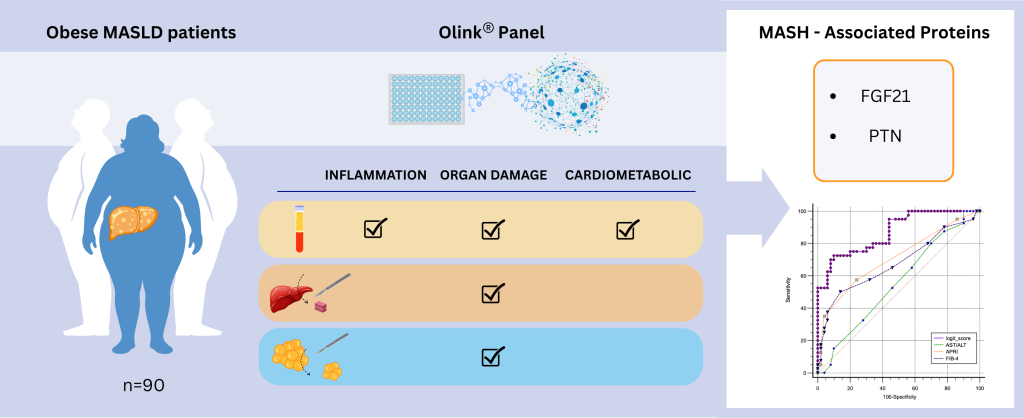
The study evaluated the plasma proteome of 90 morbidly obese MASLD patients, offering an extensive molecular snapshot of circulating proteins associated with metabolic and inflammatory pathways. This approach fills a crucial knowledge gap: while many biomarkers have been proposed individually, few studies have examined the broader proteomic landscape that may distinguish MASH from non-MASH conditions.
What the Study Reveals
The findings are both significant and promising:
- 34 plasma proteins were differentially expressed between MASH and non-MASH individuals, highlighting systemic alterations linked to inflammation and metabolic stress.
- Among these, Pleiotrophin (PTN) and Fibroblast Growth Factor-21 (FGF-21) stood out as particularly strong candidates, both showing clear associations with inflammatory features of the disease.
- A combined diagnostic model featuring PTN + FGF-21 + AST reached an AUC of 0.88, an impressive performance for a minimally invasive biomarker panel.
This result suggests that a targeted combination of circulating proteins, rather than a single analyte, may offer the sensitivity and specificity required for real-world clinical application.
Why This Matters
As MASLD continues to rise worldwide, the need for accessible diagnostic tools becomes more urgent. The ability to reliably detect MASH through a simple blood test could transform patient management, enabling earlier intervention, better risk stratification, and reduced reliance on biopsy procedures.
By integrating molecular insights with clinical indicators, this study contributes meaningfully to the development of precision, non-invasive diagnostics—one of the key priorities in modern hepatology.
Acknowledgments and Collaborative Impact
This research was made possible through the sustained support of:
- Project PRAESIIDIUM (Grant 101095672)
- Department of Life Sciences – University of Trieste (UNITS)
- Ricerca Corrente – Italian Ministry of Health
- Fondazione Umberto Veronesi ETS
- Italian Liver Foundation NPO
It represents a strong example of how collaborative, multidisciplinary research can generate clinically relevant innovations that advance both scientific understanding and patient care.