“Know more and do more for diabetes at work”
Every year on 14 November, the world marks World Diabetes Day (WDD), a global awareness campaign led by the International Diabetes Federation (IDF). The date honors the birthday of Sir Frederick Banting, who co-discovered insulin in 1921, transforming the lives of millions of people living with diabetes.
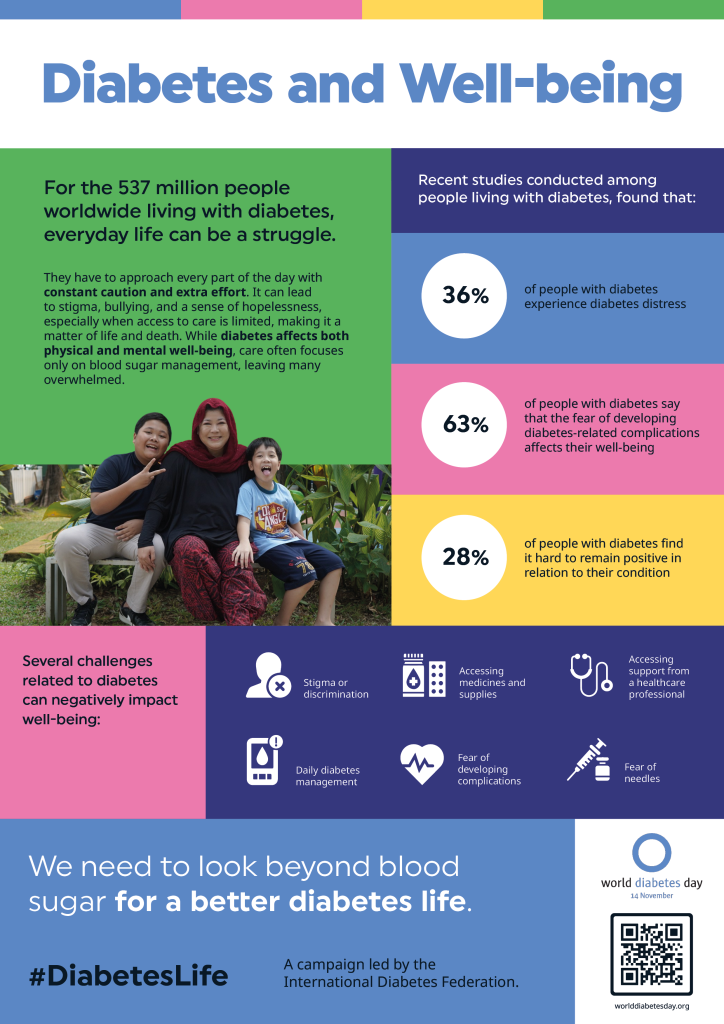
For 2024–2025, the theme of World Diabetes Day is “Diabetes and Well-Being,” with this year’s focus on diabetes in the workplace. The campaign highlights the importance of creating supportive, inclusive, and health-conscious work environments that enable people living with diabetes to thrive both professionally and personally.
The Global Picture
Diabetes continues to be a growing global health challenge:
- 589 million adults around the world are currently living with diabetes, and 7 in 10 are of working age.
- Three in four people with diabetes live in low- and middle-income countries, where access to care and workplace accommodations can be limited.
- Alarmingly, nearly half of adults living with diabetes remain undiagnosed, putting them at risk of serious complications.
Beyond physical health, diabetes takes a significant emotional toll. According to IDF surveys:
- Three in four people with diabetes have experienced anxiety, depression, or another mental health condition linked to their condition.
- Four in five report experiencing diabetes burnout, a state of emotional exhaustion caused by the constant demands of managing diabetes.
Diabetes and the Workplace
Given that most adults spend a large portion of their day at work, the workplace plays a crucial role in supporting diabetes management and well-being. Unfortunately, many people living with diabetes face barriers at work — from stigma and lack of understanding to inadequate access to healthcare, healthy food options, or time for blood sugar monitoring and medication.
Workplaces can make a difference by:
- Providing flexible working arrangements for medical appointments and self-care.
- Offering awareness training for managers and colleagues to foster understanding and reduce stigma.
- Ensuring access to healthy meals and snacks, and creating a safe space for glucose testing or insulin administration.
- Promoting mental health support and open communication about chronic conditions.
Preventing Type 2 Diabetes Before It Starts
While supporting those already living with diabetes is essential, prevention remains one of the most powerful tools in reducing its global impact. The PRAESIIDIUM Project is at the forefront of this effort, aiming to tackle Type 2 diabetes before it starts through cutting-edge technology and data-driven prevention strategies.
PRAESIIDIUM is developing an artificial intelligence (AI)-based tool coupled with multi-scale, multi-organ integrated mathematical equations for the real-time prediction of prediabetes risk in individuals.
The prediction algorithm will be trained using a rich combination of data sources — including existing clinical records, individual family histories, and insights from a pilot study using wearable sensors. These sensors will continuously monitor glucose levels, bioimpedance, and heart rate, offering a dynamic, personalized view of metabolic health.
To ensure accessibility and usability, the PRAESIIDIUM platform will be made available to both healthcare professionals and patients, providing an intuitive interface for data entry and results visualization. The system will also connect seamlessly with common wearable devices, enabling ongoing tracking of physical activity and other health parameters.
By integrating AI, mathematical modeling, and real-time data, PRAESIIDIUM aims to revolutionize early detection and prevention, empowering individuals and clinicians to intervene long before diabetes develops.
Empowering People to Thrive
This World Diabetes Day, the message is clear: supporting people with diabetes and preventing new cases go hand in hand. By raising awareness, improving care in the workplace, and advancing innovation through projects like PRAESIIDIUM, we can create a healthier future — one where every individual has the opportunity to thrive with diabetes and prevent it before it begins.