Commentary by Natalia Rosso, of the article “Serum proteome signatures associated with liver steatosis in adolescents with obesity” – Giraudi et al. J.Endocrinology Investigation .https://link.springer.com/article/10.1007/s40618-024-02419-x
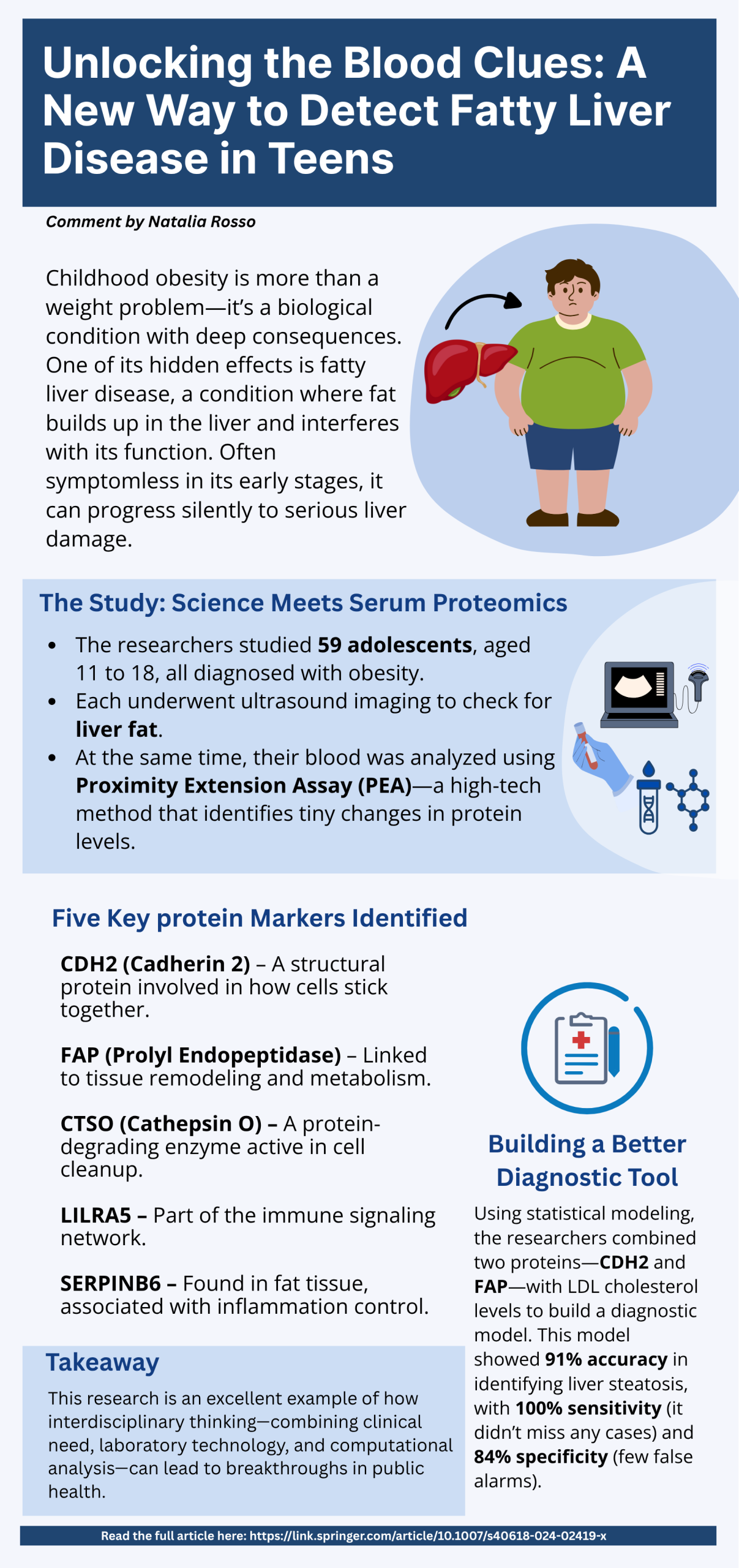
Childhood obesity is more than a weight problem—it’s a biological condition with deep consequences. One of its hidden effects is fatty liver disease, a condition where fat builds up in the liver and interferes with its function. Often symptomless in its early stages, it can progress silently to serious liver damage.
In a recent study from the consortium published in the Journal of Endocrinological Investigation, scientists from Fondazione Italiana Fegato (led by Dr. Giraudi from the MASLD Unit) explored a promising new approach to detect this condition using blood-based biomarkers. Their goal: to develop better, non-invasive diagnostic tools for teens at risk of liver disease.
Metabolic dysfunction-associated steatotic liver disease (MASLD), previously known as non-alcoholic fatty liver disease (NAFLD), represents a spectrum of hepatic disorders characterized by excessive lipid accumulation in hepatocytes. If left untreated, MASLD can progress to more severe pathological states, including steatohepatitis, fibrosis, cirrhosis, and ultimately hepatocellular carcinoma. Early-stage detection is critical for intervention but remains challenging due to the asymptomatic nature of the disease and limitations in current diagnostic methods. While liver biopsy remains the gold standard for definitive diagnosis, its invasiveness, especially in pediatric populations, limits its routine use. Non-invasive alternatives such as abdominal ultrasonography and clinical scoring indices (e.g., Fatty Liver Index, Hepatic Steatosis Index) are commonly employed but lack the sensitivity and specificity required for early and precise detection. The study under discussion investigates the potential of serum proteomic profiling to identify circulating biomarkers that could serve as reliable, non-invasive indicators of hepatic steatosis in adolescents with obesity.
The Study: Science Meets Serum Proteomics
The researchers studied 59 adolescents, aged 11 to 18, all diagnosed with obesity. Each underwent ultrasound imaging to check for liver fat. At the same time, their blood was analyzed using Proximity Extension Assay (PEA)—a high-tech method that identifies tiny changes in protein levels.
PEA works by measuring the concentration of specific proteins in the blood, even at very low levels. The team screened 184 proteins related to metabolism and cardiovascular health, hoping to find molecular “fingerprints” of liver steatosis (fat buildup).
Five Key Protein Markers Identified
From the protein analysis, five molecules stood out:
- CDH2 (Cadherin 2) – A structural protein involved in how cells stick together.
- FAP (Prolyl Endopeptidase) – Linked to tissue remodeling and metabolism.
- CTSO (Cathepsin O) – A protein-degrading enzyme active in cell cleanup.
- LILRA5 – Part of the immune signaling network.
- SERPINB6 – Found in fat tissue, associated with inflammation control.
Teens with fatty liver had significantly higher levels of these proteins in their blood. This suggests that they could serve as early indicators of the disease.
Building a Better Diagnostic Tool
Using statistical modeling, the researchers combined two proteins—CDH2 and FAP—with LDL cholesterol levels to build a diagnostic model. This model showed 91% accuracy in identifying liver steatosis, with 100% sensitivity (it didn’t miss any cases) and 84% specificity (few false alarms).
This is a major improvement over using ultrasound or traditional lab scores alone and could offer a safer, easier screening method.
Limitations and the Road Ahead
Like many scientific discoveries, this study is just the beginning. The sample size was small, and more research is needed in larger, more diverse populations. Still, it highlights the potential of integrating molecular biology with clinical practice to improve health outcomes in youth.
As tools like PEA become more accessible, they may revolutionize how we screen for and manage metabolic diseases—not just in adults, but in children too.
Takeaway
This research offers a real-world application of biology, chemistry, and data science in medicine. It’s an excellent example of how interdisciplinary thinking—combining clinical need, laboratory technology, and computational analysis—can lead to breakthroughs in public health.
Read the full article here: https://link.springer.com/article/10.1007/s40618-024-02419-x